あなたは単独のコメントのスレッドを見ています。

残りのコメントをみる →

[–]Akareyon 12ポイント13ポイント  (94子コメント)

The Twins survived the impacts just fine. The planes produced small holes and a lot of smoke.

But for the sake of argument, let's take the worst case scenario and assume the planes cut through the building like a hot knife through butter so the top 1/4 could fall unimpeded on the lower 3/4.

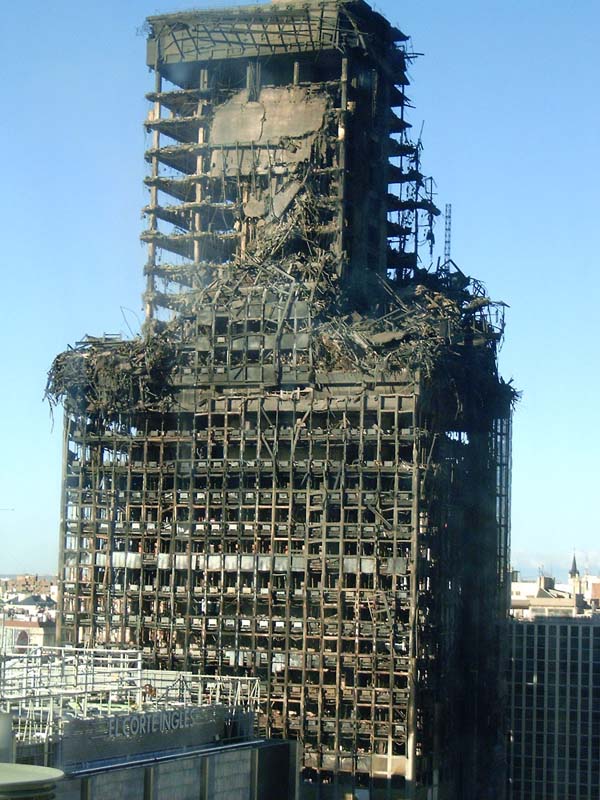
If you build a tower, pick up its top 1/4 and drop it on the lower 3/4, it will not completely collapse because the impact is damped. That means only a few floors in the impact zone get crushed, and the collapse comes to a halt. Partial collapse. Like, for example, Torre Windsor collapsed only partially.

Towers break, buckle, lean, topple, they do not completely crush themselves under their own weight unless intentionally designed to.

[–]That_Guy381 -6ポイント-5ポイント  (93子コメント)

Excuse me? Are you saying one floor crashing into another floor isn't going to bring it down? That's just denying physics. And then another. And another, and another.

[–]Akareyon 9ポイント10ポイント  (92子コメント)

And then another. And another, and another.

That's Zeno's "Achilles and the tortoise" paradox on wheels. Or a domino chain reaction. Are you saying skyscraper engineering is the art of making sure all dominos topple in a chain reaction? No, of course not.

Are you saying one floor crashing into another floor isn't going to bring it down?

I am saying that if you build a tower, pick up its top 1/4 and drop it on the lower 3/4, it will not completely collapse because the impact is damped. Only a few floors in the impact zone get crushed, energy is dissipated and "used up" for friction, deformation and heat, and eventually, the collapse comes to a halt, resulting in a partial collapse. Like, for example, Torre Windsor collapsed only partially. Towers break, buckle, lean, topple, they do not completely crush themselves under their own weight unless intentionally designed.

To prove otherwise, the scientific method is at your command: experiment or GTFO.

[–]Pvt_Hudson_ -1ポイント0ポイント  (91子コメント)

I am saying that if you build a tower, pick up its top 1/4 and drop it on the lower 3/4, it will not completely collapse because the impact is damped.

That's an awfully confident statement to make considering the scenario you're describing (a skyscraper having a large section of its upper mass dropped on it) has only happened twice in recorded history, both times leading to total collapse.

Only a few floors in the impact zone get crushed, energy is dissipated and "used up" for friction, deformation and heat

And promptly regained when the mass falls unimpeded through the open office spaces between each floor.

[–]Akareyon 3ポイント4ポイント  (90子コメント)

That's an awfully confident statement to make

So what? The confidence is backed by experiment.

It is far more extraordinary to claim that total collapse, especially the top-down mode the Twins exhibited, is "inevitable" or "natural" when it only has happened twice ever in recorded history.

considering the scenario you're describing (a skyscraper having a large section of its upper mass dropped on it) has only happened twice in recorded history, both times leading to total collapse.

That is not entirely true. While the scale of the Twins is unprecedented, towers have been dropped several times and stood, or they broke off, buckled, leaned or toppled, and never collapsed totally - disproving the claim total vertical collapse is "inevitable". Crowds laugh when that happens and make fun of the blasters. Only in an expertly designed CD do towers collapse totally. Crowds applaud and cheer and kids want to become blasters when that happens.

Only a few floors in the impact zone get crushed, energy is dissipated and "used up" for friction, deformation and heat

And promptly regained when the mass falls unimpeded through the open office spaces between each floor.

There is nothing that would make that assertion believable.

If more energy is to be regained than dissipated, it means that the structure was intentionally designed to do so, which is a feat in and by itself - and so hard to do that to this day, there is no experiment to prove your claim. Except domino chain reactions. Were the towers a domino set-up? Is skyscraper engineering the art of making it so that all dominos fall?

Of course not.

The scientific method. Experiment or GTFO.

[–]Pvt_Hudson_ 0ポイント1ポイント  (89子コメント)

That is not entirely true. While the scale of the Twins is unprecedented, towers have been dropped several times...

When? What comparable steel framed structure are you using? What skyscraper has had its top quarter dropped on it?

Only a few floors in the impact zone get crushed, energy is dissipated and "used up" for friction, deformation and heat

There is nothing that would make that assertion believable.

Except for reality.

Massive portions if the towers were offering no resistance at all. The rubble was able to regain any energy it lost when it encountered massive open floor spaces to fall through.

[–]Akareyon 2ポイント3ポイント  (88子コメント)

That is not entirely true. While the scale of the Twins is unprecedented, towers have been dropped several times...

When? What comparable steel framed structure are you using? What skyscraper has had its top quarter dropped on it?

No shifting of goalposts, please. Towers of smaller scale have been dropped several times and global progressive collapse did not ensue, instead, it was arrested. This statement is true. When vertical total progressive collapse happened, it was always due to controlled demolitions. This statement is also true. A model of a tower will not exhibit the Twin's behaviour when the top 1/4 is dropped on the rest unless intentionally made to. This statement is also true. In boring, lazy, uninteresting demolitions, a tower falls over, or distinctly sideways. This statement is also true.

Nothing ever exhibited the Twin Towers' collapse mode unless intentionally designed to, no matter the scale. This statement is also true.

Massive portions if the towers were offering no resistance at all. The rubble was able to regain any energy it lost when it encountered massive open floor spaces to fall through.

But the core and perimeter columns also came down. That is not possible in your scenario where everything falls through the open floor spaces. Either the whole core would remain standing, as it did in Madrid, or the perimeter would stay up with the innards gutted, like WTC5.

What you describe does not explain total collapse.

[–]Pvt_Hudson_ 0ポイント1ポイント  (87子コメント)

No shifting of goalposts, please.

I'm not shifting anything. You're the one saying that "if you build a tower, pick up its top 1/4 and drop it on the lower 3/4, it will not completely collapse because the impact is damped". I'm asking what real world comparable you are using to make that determination.

You've already admitted that "the scale of the Twins is unprecedented". Dropping the top 1/4 of a building on the bottom 3/4 would be equally unprecedented...unless you can come up with another steel framed skyscraper that has had that happen to it.

But we both know you can't.

So what we end up with is a building of unequalled size suffering damage that had never been seen before (and that no building on earth is designed to withstand)...and yet somehow you're surprised that the end result is unpredictable.

A model of a tower will not exhibit the Twin's behaviour when the top 1/4 is dropped on the rest unless intentionally made to

This statement means sweet fuck all without any comparable size structures suffering comparable damage to be able to refer to.

I'm sure you can build a 5 foot "tower" out of toilet paper rolls and chicken wire and have it stand up, but that isn't really a good comparable, is it?

But the core and perimeter columns also came down

Would you expect 80 stories of unbraced and heavily damaged core columns to stand on their own?

Would you expect the pre-fabricated sections of perimeter columns to not break their connections?

The core of both towers did stand for 10 or 15 seconds before eventually collapsing themselves.

[–]Akareyon 2ポイント3ポイント  (86子コメント)

You're the one saying that "if you build a tower, pick up its top 1/4 and drop it on the lower 3/4, it will not completely collapse because the impact is damped". I'm asking what real world comparable you are using to make that determination.

Small scale experiments of course. I built towers, picked up their top 1/4 and tried to initiate collapse. I found out how I could do it, but that it would require me to build them intentionally so they collapse. But you don't want to argue that the Twins were intentionally built so they collapse, do you?

Dropping the top 1/4 of a building on the bottom 3/4 would be equally unprecedented...unless you can come up with another steel framed skyscraper that has had that happen to it.

The material doesn't matter, nor the scale. Towers damp the progression until it comes to a halt, or they topple, break, shear or buckle as a whole. You must design them intentionally if they are to exhibit the Twins' failure mode.

So what we end up with is a building of unequalled size suffering damage that had never been seen before (and that no building on earth is designed to withstand)...and yet somehow you're surprised that the end result is unpredictable.

We end up with a building a little taller than most other buildings suffering damage that they were designed to withstand and somehow you pretend it's the most natural thing to expect when they exhibit a failure mode that has never ever been observed before or after - except if engineered intentionally.

I'm sure you can build a 5 foot "tower" out of toilet paper rolls and chicken wire and have it stand up, but that isn't really a good comparable, is it?

So your theory is that although 2cm, 20cm, 2m, 20m and 200m towers need to have their total progressive collapse intentionally engineered, 400m towers magically behave vastly differently and do so on their own accord? At what size does the failure mode of a tower transition from a distinctly sideways motion (toppling, leaning, shearing, buckling) to a axially, vertically symmetrical straight-down trajectory? What "science" is that based on? Relativity theory?

Would you expect 80 stories of unbraced and heavily damaged core columns to stand on their own?

What damaged these 80 stories so heavily?

Would you expect the pre-fabricated sections of perimeter columns to not break their connections?

Why should they?

The core of both towers did stand for 10 or 15 seconds before eventually collapsing themselves.

That does not save your case. It collapsed.

The core of Torre Windsor remained standing up, as did the cores of surprisingly many "demolition fails".

But that is not what you are trying to prove. You are trying to prove a total progressive collapse without additional energy hidden in the building. But you have not a single experiment, model or analogy. You invoke Zeno's "Achilles and the tortoise" paradox of debris magically smashing the core AND the perimeter in a Gedankenexperiment that simply doesn't work the way you think it works.

So all you can do is to pretend the sheer size of the Twins explains it all, just to hand-wave away the fact that you have no experiment to back up your claims.

Too big to not fail, eh? ;)

[–]Pvt_Hudson_ 0ポイント1ポイント  (85子コメント)

Small scale experiments of course. I built towers, picked up their top 1/4 and tried to initiate collapse

And you built those towers as exact replicas of the design of the twins? Complete with core column sections fastened together (not one long fucking broomstick down the middle), pre-fabricated perimeter sections held together with tiny bolts, lightweight trusses fastened to teeny tiny gusset plates, and a hat truss to distribute weight?

And then you dropped the top section of your replica twin tower from a height of 12 feet or more?

I'm gonna go ahead and say no, you didn't.

The material doesn't matter, nor the scale

http://imgur.com/voRrHcT

Tell that to any structural engineer and watch them laugh you out of the room.

So, by your failure to find any real world examples of steel framed open floor plan skyscrapers that suffered a comparable collapse initiation event as either of the twins did, I'm going to go ahead and take that as an admission that what happened to the twins that day (top 1/4 of a skyscraper dropped on lower 3/4) has never been seen before.

At what size does the failure mode of a tower transition from a distinctly sideways motion (toppling, leaning, shearing, buckling) to a axially, vertically symmetrical straight-down trajectory?

Find me an example of any steel framed skyscraper in history that had it's top 1/4 dropped vertically on its lower 3/4 and had the collapse topple to the side or lean.

What damaged these 80 stories so heavily?

Well, for starters, the twins both had massive fucking hat trusses at the tops of the towers that were meant to shift and distribute weight between the core and perimeter columns. When the top section of the building was dropped, guess what was falling right down the center?

http://imgur.com/X9mJhqw

http://imgur.com/1FgDrIK

Riiiiiight, those massive fucking hat trusses.

The core of Torre Windsor remained standing up

Steel reinforced concrete.

Also, the Torre Windsor didn't have the top 1/4 dropped on the lower 3/4, so the comparison isn't applicable at all.

Also, the Torre Windsor had every single structural steel component collapse in under 3 hours. The only thing that remained standing was made of steel reinforced concrete.

But that is not what you are trying to prove. You are trying to prove a total progressive collapse without additional energy hidden in the building. But you have not a single experiment, model or analogy

Just like you don't have a single real world comparable that shows what happens when a huge open plan steel structured skyscraper has 1/4 of the building dropped on the bottom 3/4.

Sorry man, 5 foot tall backyard experiments with plywood held together by glue sticks don't really count.