Farewell, Japan.

The end is drawing near…. The semester is almost over and so will my study abroad experience. Soon I will be returning back home to the USA, leaving Japan. I have enjoyed living in Japan for these past 4 months. It’s been a great experience. I’ve learned so much from all the different people I’ve met and things I’ve done.

I’ve explored a lot of Tokyo for the most part, going to the major places like Shibuya, Harajuku, Shinjuku, Roppongi, and etc…as well as visiting random stations on the subway.

I’m really going to miss everything here like:

  • The food. (It’s delicious and better quality. I’ll probably end up looking up recipes for Japanese food. I love the bakeries, tempura, katsudon, croquettes, onigiri, sushi, etc…)
  • Living in a small neighborhood area. (It’s a nice area to live in near food and small shops. Japan also seems much safer to live in. It has some areas that you should probably avoid, but for the most part, if you’re just walking around, you won’t have your stuff stolen by pickpockets or get mugged by a stranger.)
  • Extensive public transportation network. (You can go anywhere on public transportation without needing a car. You can even visit other cities by taking the Shinkansen. Also, most subway stations also have restrooms and snack stands and escalators and gates so that you don’t fall onto the subway tracks.)
  • Konbinis. (Konbinis are actually conveniently everywhere with decent food.)
  • The cleanliness of the city. (Big cities in the USA like Philadelphia and New York have litter and trash on the ground and are so dirty compared to Japan.)
  • Living in an international city. (Tokyo is where lots of foreigners come to visit and also work. I met a lot of different people at Temple University Japan campus who are from a lot of different places like Norway. Germany, Malaysia, Taiwan, China, and from all over the USA from the west coast to the east coast and from in-between like Iowa.)
  • Exploring new places. (I have visited so many new places, in Tokyo, just outside of Tokyo, Osaka, Hiroshima, etc… It’s been great visiting such interesting places.)
  • LOTS OF OTHER THINGS TOO….


Crash Course in Chopsticks

One thing I’ve realized while living in Japan is that you should really learn to use chopsticks before you come here or you’ll get a crash course in using chopsticks when every restaurant you go to only offers you chopsticks.

I was lucky and already knew how to use chopsticks since I’m only a first generation Asian American, so I actually use chopsticks at home sometimes.

However, I have seen some other people struggle too eat with chopsticks. In Japan, you typically use forks and knives for western-style meals like eating steak, which I think would definitely require a fork and knife. Spoons are used often enough since they’re useful for soups and noodles.

The majority of the time, you eat with chopsticks. If you buy a meal, it comes with chopsticks. If you eat out, they offer chopsticks. You might be able to ask for a fork, but it might be a little awkward to ask for a fork every time you eat out.

Brief Chopstick History

Why do Asian eat with chopsticks, you might wonder. Well, one response is Confucius.

As a vegetarian, he believed that sharp utensils at the dinner table would remind eaters of the slaughterhouse. He also thought that knives’ sharp points evoked violence and warfare, killing the happy, contended mood that should reign during meals. Thanks in part to his teachings, chopstick use quickly became widespread throughout Asia. (www.history.com)

Moreover, chopsticks work really well with Asian rice.

In Asia, the majority of rice is either a short or medium grain variety often with starches that are particularly gummy or clumpy. As such, it sticks together and is quite easily picked up by chopsticks. In comparison, many Westerners eat long grain rice (often highly processed) with is much fluffier and the individual grains are more distinct and for the unpracticed hand, difficult to eat with chopsticks. (www.todayifoundout.com)

These are just some of the reasons for using chopsticks.

If you need another reason, well, I have heard that chopsticks make you eat slower or at least smaller bites at a time, thus allowing your stomach to digest food better.

Chopstick Etiquette

Here’s a video for how to correctly hold your chopsticks.

http://www.youtube.com/watch?v=m94My4XkZTo

There is more to just holding your chopsticks correctly. There are rules for what you shouldn’t do. Some are just common sense and some have cultural connotations involving funeral rituals using chopsticks.

Some Chopstick Rules:

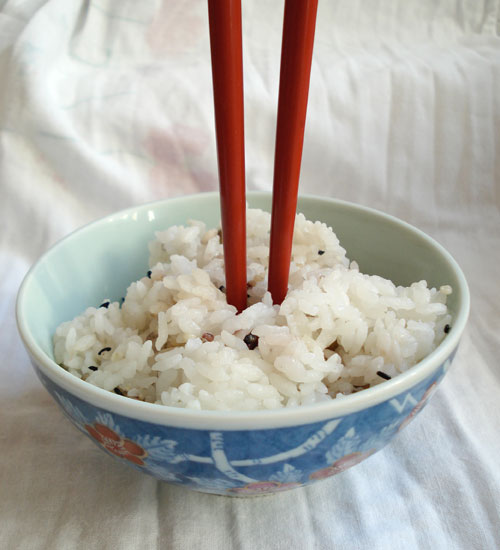
1. Don’t stick your chopsticks into your bowl straight up. (This is unacceptable in most cultures that use chopsticks.)

2. Don’t pass food from chopstick to chopstick.

3. Don’t spear your food with your chopsticks.

4. Don’t hold the chopsticks in your mouth as you do something else. (That is just plain dangerous. You could fall and stab yourself in the mouth.)

Here’s a more in-depth guide to chopstick etiquette below. It even tells you why you shouldn’t do something due to cultural reasons or it is just plain dangerous. I was taught similar things but not the same since I’m not Japanese, I’m Taiwanese American.

http://justhungry.com/your-guide-better-chopstick-etiquette-mostly-japanese

I also found a guide to chopstick etiquette around the world if you’re interested in the differences in between the various Asian cultures that use chopsticks.

http://blog.everythingchopsticks.com/guide-to-chopsticks-etiquette/

If you’re also interested in other table manners and etiquette on how to eat and drink and what not to do when eating in Japan. Here’s another link I found that tells you about what is rude to do.

http://www.japan-guide.com/e/e2005.html

 .

.

REFERENCES

http://www.history.com/news/hungry-history/a-brief-history-of-chopsticks

http://www.todayifoundout.com/index.php/2013/12/asian-nations-use-chopsticks/

Konbini Food

I have to say that konbini food is pretty good here. For those of you who have no idea what I’m talking about, konbini, is the Japanese term for convenience stores. Konbini’s in Japan are great. They actually have decent food for cheap that they will microwave for you and give you chopsticks and toothpick. If you compare these convenience stores to those in the USA, Japan definitely seems to have better variety of food and actual meals-to-go while the USA convenience stores typically have mostly snacks and drinks and don’t really have decent meals to buy.

There seem to be three major konbinis that I have noticed: 7-11, FamilyMart, and Lawson. In Tokyo, I think you can typically find a konbini on every few blocks or not even that far apart from each other. They are within walking distance of each other. They are that common in Tokyo, at least.

Anyway, the food is good and somewhat cheap if you’re looking for a quick, convenient meal near the school. I mean you should spend money on some of the good food in Japan, but when you’re just eating lunch at school, you can get it from the konbini, though there is also the option of late-night discount meals from your local supermarket that you could buy the night before and bring to school.

So, konbinis offer a variety of food choices. They have containers with meals for about 300 yen to 600 yen with foods like spaghetti, meat on rice, anything on rice, sushi, dumplings, and etc… They also have sandwiches and baked goods for about 100 yen to 300 yen.

There are meals with chicken and rice as well as random breaded fish and meat with rice. If you don’t know what it is, but it’s breaded something, try it anyway since it will probably be good.

They also have katsudon, breaded chicken with egg and sweet onion on rice, which I love to eat whether it be from the konbini or a restaurant. おいしいです。(Delicious.) Here’s a picture of katsudon along with miso soup. You receive miso soup with a lot of meals in Japan. You get used to the taste after a while.

Miso soup is a soup with seaweed in it. I’m not sure of the particular ingredients of it, but it’s good.

They also have curry as well as omurice, the Japanese omelette over rice with ketchup on top. The omurice from konbinis aren’t as creative as the images below, but maybe this is an idea for food to find in Japan. Maybe find a restaurant that decorates omurice for you, if you visit.

Omurice can be quite creative. I found some fun examples online.

There are also other options that I haven’t mentioned as well as lots of snacks.

You could even buy your groceries from the konbini if you’re that desperate to cook something.

Then, there are onigiri, which I totally recommend.

Photo Nov 17, 17 49 38

Onigiri are good, around 100 yen or more. It depends on if they have a special on onigiri going on or if you get special onigiri like salmon onigiri. They have a variety of onigiri from plum to fish roe to salmon. I actually translated the kanji and kana. Here’s some of what they have: tuna, kelp, cod roe, dried plum, walleye pollack roe, and shrimp. It gets really confusing.

Photo Nov 17, 18 23 22Photo Nov 17, 18 23 44Photo Nov 17, 18 25 49Photo Nov 17, 18 23 59


Photo Nov 17, 18 26 24

Photo Nov 17, 18 26 58

Photo Nov 18, 01 09 51Photo Nov 18, 01 09 56


These are just some of the ones that I translated.

There’s also mayonnaise in the onigiri, which really makes it taste good.

Photo Nov 17, 18 23 36

It’s really useful to translate Japanese to English to figure out what you’re eating or buying. Quite useful.

So, konbinis are way better in Japan than in the USA and offer decent choices in food.


Okunoshima, Where Bunnies Roam Free

DSC_0479

So last weekend I visited Hiroshima city in the morning before turning my attention to a little island nearby in the Inland Sea of Japan known as Okunoshima. I had major plans for the rest of my day.

What is on this less known island?

Well, it has outdoor activities, hiking, biking, and a resort. However, it also has….BUNNIES roaming free around the island and a history with poison gas.

DSC_0476

So, Okunoshima had an active poison gas factory during World War II, producing chemical weapons. The story goes that they tested the poison gas on unfortunate rabbits that they brought to the island, which were set free after the war with their descendants roaming the island. Or schoolchildren brought them to the island. Either way, rabbits were brought to the island somehow and multiplied like crazy without any predators to control their population size.

From Hiroshima, I took the JR Sanyo Line to Mihara Station and then transferred to the JR Kure Line to Tadanoumi Station. The JR Kure train does not come that often, so you have to check the schedule. There is also the option of taking the JR Kure Line Rapid to Hiro Station and then transfering to JR Kure Line Local to Tadanoumi. Or the more expensive option of taking the Shinkansen Kodama to Mihara Station and transferring to JR Kure Line. Either way, it gets you where you’re going.

I had a nice scenic view of the coast, going from Mihara to Tadanoumi on the JR Kure Line. It was strange how nice the weather was, despite being the end of November.


Short clip of train ride to Tadanoumi Station.

Anyway, once I arrived at Tadanoumi Station, I walked out of the station and turned right and saw a giant map. The map is quite useful. Anyway, once you walk out of the station, you should turn right and keep walking until you see a sign for the Tadanoumi Port. If you turn left out of the station, you’ll see a Family Mart, which means you’re going the wrong way. So turn right!

You know you’re going the right way once you see the blue sign. Turn right when you see the sign for Tadanoumi Port. I think you would easily find your way to the port because you could just follow the other people. Most of the people who were on the train with me, were also going to Okunoshima.

DSC_0328

Apparently, Okunoshima is a good place for picnics and definitely a good place to take your kids for a day trip to see the bunnies.

At Tadanoumi Port, you have to buy ferry tickets for roundtrip (about 620 yen) at the machine or ticket window. You might want to ask someone if the boat goes to Okunoshima since some boats go to other islands.

You might also want to hurry to the port from the train station since the boat leaves every half hour. It seems to typically be ready to leave around the time your train arrives at the station, so you might want to run. Personally, I ran all the way to the port because I was excited and then I was in hurry once I saw people boarding the ferry.

Short video clip of the ferry ride.

I immediately went to the back of the boat to get a good view of us leaving port. It took maybe 10-15 minutes to reach Okunoshima.

DSC_0339

DSC_0346

It was exciting once we arrived at Okunoshima. I immediately saw bunnies just hanging around a small field. People were feeding them cabbage and carrots and feed pellets.

They were so cute and friendly. You could go up to one and pet it. If you had food, they would come up to you and maybe stand up against your knee for the food. Sadly, I didn’t have food, but I watched others feed the bunnies.

DSC_0365

 These rabbits definitely don’t go hungry.

DSC_0369

DSC_0370

DSC_0373

So cute! That black bunny is just lounging around. Must have eaten too much.

DSC_0381

DSC_0382

DSC_0384

DSC_0386


Well, hello there, little cottontail.

DSC_0387


Oh, you heard me. Well, hello!! I don’t have food for you, but I love you because you’re adorable.

DSC_0389


They will do anything for food like stand up.

DSC_0390

DSC_0392


These two are just taking their afternoon nap.

DSC_0393

DSC_0395

DSC_0398


Can you spot all the bunnies the photo above? They blend in really well.

DSC_0400

I left the area to walk down a road and saw a nice view of the sea and more bunnies on the side of the road.

DSC_0405

DSC_0406

DSC_0407

Lovely view of the sea and…More rabbits!

DSC_0408

DSC_0409

DSC_0412

It was like it was not November there. Nice weather and beaches and bunnies and sun.

DSC_0413

DSC_0415

DSC_0418

DSC_0421

DSC_0425

DSC_0429

Bunny!

DSC_0431

Fishing on the small dock. It’s an easy time on this island.

DSC_0432

DSC_0433


Another bunny! It’s hiding under the boardwalk.

DSC_0434

It came out for the food pellets.

DSC_0436

It’s bright and sunny, and there’s a beach. This definitely doesn’t feel like November.

DSC_0437

DSC_0439

DSC_0447

DSC_0449

DSC_0452

DSC_0454

DSC_0459

Possibly a little rabbit romance going on here. I’ll just give them some alone time.

DSC_0462

DSC_0463

More rabbits just hanging around on the beach.

DSC_0464

Beach.

DSC_0465

DSC_0467


Taking the road less traveled….

DSC_0468

DSC_0469

DSC_0470

DSC_0471

DSC_0472

Well, hello there, little black bunny. Have you come to show me around the island?

DSC_0476

DSC_0477

DSC_0480

DSC_0482

DSC_0483

DSC_0485


I’m just following this path to wherever it takes me.

DSC_0486

DSC_0487

DSC_0489

Hello, bunny. Sorry, I don’t actually have food, though you are really adorable, especially standing up for food.

So, the path took me to more bunnies and the island resort.

DSC_0492

DSC_0493

DSC_0494

Bunnies hiding in the sand. Beach bunnies.

DSC_0495

DSC_0499

Some more rabbits hanging around the remnants of an air-raid shelter for military chiefs.

DSC_0500

DSC_0501

Well, time to head back to the dock and find my way home to Tokyo.

DSC_0502

Okay, maybe some more photos of bunnies as well.

DSC_0503

More bunnies!

DSC_0510

I wish I could have explored more of the island. I only explored part of the island since I didn’t have that much time on the island. There were sites of military installations and things about the poison gas factories that once existed on the island.

I did briefly visit the Poison Gas Museum. It’s pretty small and a lot of it was in Japanese, but there was some English. Apparently, the toxic waste from the poison gas manufacturing was placed into ceramic containers, so if you see any around the island, you should probably avoid getting too close.

Visiting Okunoshima was fun. If you get the chance, you should take a whole day or two to explore the island and feed and pet bunnies.


Peace Park in Hiroshima

DSC_0251

A-Bomb Dome

Last weekend, I visited Peace Park in Hiroshima. So, if you remember your history, Hiroshima and Nagasaki were the two cities in Japan that the United States dropped atomic bombs on in 1945 during the final stages of World War II. According to Wikipedia,

Within the first two to four months of the bombings, the acute effects of the atomic bombings killed 90,000–166,000 people in Hiroshima and 39,000–80,000 in Nagasaki; roughly half of the deaths in each city occurred on the first day. During the following months, large numbers died from the effect of burns, radiation sickness, and other injuries, compounded by illness and malnutrition. In both cities, most of the dead were civilians, although Hiroshima had a sizable military garrison.

It also remains the only time nuclear weapons were ever used in warfare, which is both good and bad since it was only used once but that fact that it was used at all is bad.

DSC_0261

Close up of part of A-Bomb Dome

I saw the A-Bomb Dome. It is more than just a ruin of the “Hiroshima Prefecture Industrial Promotion Center.” According to visitHiroshima.net,

It has become a symbol of hope and peace, demanding the abolition of nuclear weapons. This dome represents all the hopes for peace that Hiroshima and all other people in this country are sending out to the world, with a wish to realize eternal peace.

The entire idea of Hiroshima’s Peace Memomrial Park is as a reminder of the horrors of nuclear weapons and to advocate for world peace.

DSC_0272

Memorial Tower to the Mobilized Students

Here is the Memorial Tower to Mobilized Students.

DSC_0267

During World War II, there was a shortage of laborers in factories, so the government established the Student Labor Service Act in 1944. Students in middle school and higher were required to work in munitions factories and other tasks. When the atomic bomb was dropped, about 6,300 students were killed.

DSC_0269

Some carvings of students working in factories and such.

DSC_0270

This was an aspect that I had never heard of before with students being forced to work in factories.

DSC_0271

The Japanese have a tradition of hanging cranes on different things. I’ll explain more once I get to the Children’s Peace Monument.

DSC_0274

DSC_0277

I noticed some birds on the tower. I believe those are doves to symbolize peace.

DSC_0279

DSC_0280

DSC_0285

Here’s a smaller memorial. I don’t remember what it was for exactly. There were a ton of memorials in Peace Park. However, the most famous one, I think, is the Children’s Peace Monument.

DSC_0289

Children’s Peace Monument

To understand this memorial, you have to know the legend behind the paper cranes and the story of Sadako Sasaki.

There are different versions of the story of Sadako Sasaki, so I’m not sure which is true. Anyway, Sadako Sasaki was two years old when the atomic bomb was dropped on Hiroshima. Her exposure to the radiation caused her to develop leukemia nine years after the bombing.

In 1954, she was diagnosed with leukemia (also called the atom bomb disease) in sixth grade and was admitted into the hospital. She believed that folding a thousand paper cranes would help her recover. She did finish folding a thousand cranes and continued folding on past that. However, she eventually passed away in 1955 after several months of struggle with the illness.

Ancient Japanese legend promises that anyone who folds a thousand origami cranes will be granted a wish by a crane. Senbazuru (Thousand Origami Cranes) is a tradition for the Japanese people to fold a thousand cranes and string them together for good luck, good health, recovery from illness, or other reasons.

Her story became famous and people from all over Japan donated money to build the memorial to commemorate the children who were victims of the atomic bomb. She wasn’t the only child who died from the effects of the atomic bomb, but she became the most famous story.

A bronze girl who holds a gold crane is standing on the top of the tripodal domed statue, and located next to the domed statue, there are the statues of boys and girls symbolizing bright future and hope. (visithiroshima.net)

DSC_0295

DSC_0291

People from all over the world send a thousand paper cranes or so to the monument as a symbol of their desire for peace.

DSC_0292

DSC_0293

DSC_0294

DSC_0311

DSC_0296

DSC_0298

This is the Flame of Peace, a symbol of hope for world peace. According to visitHiroshima.net,

The pedestal was designed to suggest two hands pressed together at the wrist and bent back so that the palms point up to the sky. It has become the symbol of Anti-nuclear weapons, sending the following message: “Let’s keep burning the fire until nuclear weapon is eliminated from the entire earth”.

DSC_0304

Cenotaph for A-Bomb Victims was to change Hiroshima into a city of peace with the desire for the abolition of nuclear weapons.

The cenotaph carries an epitaph: “Rest in Peace, for the error shall not be repeated”. The central stone room carries the list of name of both domestic and overseas A-bomb victims. (visithiroshima.net)

DSC_0306

Below is the Peace Bell. They carved the world map on the bell without any borders between countries to symbolize “one world.”

The bell was designed in a form of a logo expressing the need to ban atomic and hydrologic power, and on the opposite side of the bell, there is a mirror which reflects the inside of one’s heart to the sound of the bell. (visithiroshima.net)

I went up to the bell and tried to ring it, but it’s pretty difficult to do so.

DSC_0319

DSC_0315

There were many more memorials throughout the park, but I didn’t see them all. A lot more things happened than you realize when the atomic bomb was dropped in 1945. I learned a lot more about how much it affected people after visiting Peace Memorial Park. The effects of nuclear weapons can take a devastating toll on people.

Kushikatsu at Daruma in Dotonbori Street, Osaka

Osaka has good street food like okonomiyaki, takoyaki and kushikatsu. Osaka is known for its food culture. It is the “kitchen of Japan” from what I read online, and it is based on Dotonbori Street.

On my way to Dotonbori Street, I stopped for street food at a random okonomiyaki place on the street. They were cooking the okonomiyaki outside in the sidewalk area, so you could tell it was fresh as you watched them make it for you. There were a couple of seats on sidewalk, so I bought an okonomiyaki and sat down to eat. It was good. It was a different style from what I have eaten before, but it was just as delicious.

Photo Nov 23, 17 19 51

My next stop was Dotonbori street. I was in search of one particular food: kushikatsu. I had yet to try this particular food, so I was determined to find a place to eat it.

There was a recommendation online for a famous kushikatsu place: Daruma.

Photo Nov 23, 18 28 36

If you can’t tell from the picture, that is a long line waiting to get into Kushikatsu Daruma.

Photo Nov 23, 19 17 37


Those are not just random people standing in the middle of the street. They are waiting to eat at Daruma.

Photo Nov 23, 18 39 11


The place has an angry-looking chef holding kushikatsu in his hands standing in front of the restaurant.

Photo Nov 23, 19 17 34

Photo Nov 23, 18 42 33

A much clearer view of the sign.

Photo Nov 23, 18 53 17


Photo Nov 23, 18 53 29


The dipping sauce is already sitting in front of you. So let me explain kushikatsu.

Photo Nov 23, 18 55 04


Kushikatsu are battered and deep fried pieces of food on skewers. It was fun trying out the varietieis of kushikatsu, especially since I picked random ones from the menu since it was in Japanese. I could at least read katsu (かつ) at the end of some items which means it’s something and pork. Apparently, I picked some good ones. I got cheese, mochi, cheese and something, sausage, pork, and some other ones that I don’t quite remember. It was quite good. I ordered more right after I finished. One major MAJOR rule when eating kushikatsu is that There is NO DOUBLE DIPPING. It’s a serious rule. When you eat kushikatsu, you dip into a sauce. And the sauce is a communal, so other people will also be using it. It’s just more sanitary to dip it once before you eat it.

Photo Nov 23, 19 02 29


Picture of the menu. If you can actually read that, then you’ll find some interesting things on there, I think. I believe there is fried battered mochi.

Photo Nov 23, 19 06 10


Kushikatsu that has been dipped.

Photo Nov 23, 19 06 45

More kushikatsu! Yes, I did order more. It was really good. Of course, anything fried usually tastes pretty good.

Photo Nov 23, 19 19 59

Just another view of the angry chef.


Osaka, the City of Delicious Food – Part 2

After going through the Osaka Castle Museum and the surrounding area, I headed straight for food, which means Dotonbori Street! Dotonbori street is The street to be to find food. Osaka is known for its food culture as well as its giant famous signs like the giant crab…

DSC_0151

DSC_0156

DSC_0158

….and the famous Running Man sign below.

DSC_0161

I’ll be talking more about food in Osaka in my next post, so stay tuned. I tried some good kushikatsu.

DSC_0163

DSC_0168

They already have Christmas decorations up in November. The Japanese don’t celebrate Thanksgiving since it’s an American holiday. However, they do celebrate Christmas with Santa Claus and Christmas lights and decorations and music everywhere.

DSC_0171

Below is a picture the bottom of the Floating Observatory at Umeda Sky Building. It looks pretty cool, especially once up get up there to see the view.

DSC_0173

DSC_0174

They have a floor with a small cafe and seats in front of windows looking out over the city. It was a nice place to take a break and have some Hokkaido ice cream, which is some of the best ice cream you can eat due to its rich milk flavor. Hokkaido produces some really delicious and rich milk, which makes delicious ice cream.

DSC_0183

DSC_0191

This is the top of the building. The floor is pretty cool, looking like the night sky filled with a billion stars on a clear night.

DSC_0211

For couples, there is the Lumi deck where you can place your love locks. You can buy a lock and place it up there with the other few hundred or so locks to symbolize your love.

DSC_0225

Lots of night views of the city.

DSC_0241

DSC_0242

DSC_0247

There is also an area where you can write your wish on a star and hope it comes true.

DSC_0250


Previous Older Entries

Follow

Get every new post delivered to your Inbox.