Japan’s pundits are at it again: debating what to do about the sinking demographic ship. With the low birthrate, aging and shrinking society (we dropped below 127 million this year) and top-heavy social security system, Japan’s structural problems will by many accounts spell national insolvency.
However, we’re hearing the same old sky pies: proposals to plug the gaps with more Japanese babies, higher retirement ages, more empowered women in the workplace — even tax money thrown at matchmaking services!
And yet they still won’t work. Policymakers are working backwards from conclusions and not addressing the structural problems, e.g., that people are deserting the depopulating countryside for urban opportunities in an overly centralized governmental system, marrying later (if at all) and finding children too expensive or cumbersome for cramped living spaces, having both spouses work just to stay afloat, and feeling perpetual disappointment over a lack of control over their lives. And all thanks to a sequestered ruling political and bureaucratic elite whose basic training is in status-quo maintenance, not problem-solving for people they share nothing in common with.
Of course, proposals have resurfaced about letting in more non-Japanese (NJ) to work. After all, we have that time-sensitive 2020 Tokyo Olympics infrastructure to build — oh, and a Tohoku to reconstruct someday. And no self-respecting white-collar Taro wants those 3K (kitsui, kitanai and kiken — difficult, dirty and dangerous) jobs. Never mind that policymakers have rarely cared about the NJ already here investing their lives in Japan, long discouraged from settling via revolving-door visa regimes, and even bribed to leave in 2009.
So, come back! All is forgiven!
Predictably, the Shinzo Abe administration recently announced the expansion of the “trainee” program. You know, that exploitative, abusive and unmonitored system that has imported NJ since 1990, free from the protections of labor law? The one that causes dozens of NJ deaths from overwork and other “unknown causes” every year, and keeps many in conditions of virtual slavery? Despite a decade of criticisms from human-rights groups, parliamentarians and the United Nations, these three-year visas have been lengthened by two more so we can exploit them longer.
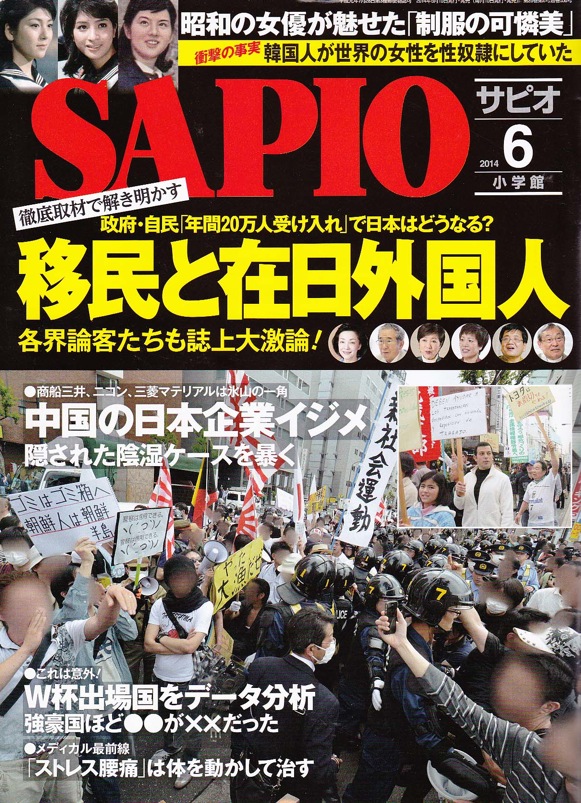
And then, a previously taboo word entered the discussion: imin (immigration). It made such an impact that prominent debate magazine Sapio made it June’s cover story. Michael Hoffman reviewed this spread in the JT in his Big In Japan column on May 24, “Will Japan be a country that welcomes all?”
Great. But I’ll answer Michael’s question right now: no — and not just for an obvious reason like Japan’s innate mistrust of outsiders. We also have a structural problem with how the concept of imin is being framed. It goes beyond constant othering and alienation: NJ aren’t even being seen as people.
Last time this debate came up, I lambasted the government for shutting NJ long-termers out of the deliberation councils drafting policies affecting them. I also mentioned how policymakers avoided the word imin.
So now imin has been formally broached — albeit while being stigmatized: The person in charge of the Immigration Bureau, Justice Minister Sadakazu Tanigaki, immediately said NJ would present “adverse effects on security.” (Note to ad agencies: Don’t hire Tanigaki to sell your product.)
But imin has also been dehumanized. Look up “immigrant” in an English-Japanese dictionary and you get words such as ijūmin, ijūsha, imin rōdōsha and, oddly, mitsunyūkokusha and fuhō nyūkokusha (illegal immigrant). But these aren’t immigrants: These are migrants, here temporarily, as properly translated by domestic NGOs looking out for NJ interests, such as the Solidarity Network with Migrants Japan (Iju Rodosha to Rentai Suru Network).
The word for “immigration,” meaning something permanent, is imin — denoted on the Denshi Jisho dictionary site as a “sensitive” word (of course; that’s why the government avoided using it for so long).
But we still have no word for an immigrant as an individual person, such as iminsha, with its own honorific sha — in the same vein as ijūsha (migrant), rōdōsha (laborer), teijūsha (settler, usually a Nikkei South American), zairyūsha (temporary resident), eijūsha (permanent resident) and even (in a few government documents) kikasha (naturalized citizen).
It’s just the clipped imin. That means nobody gets to claim “I am an immigrant” in Japan. (Try it: “Watashi wa imin desu” sounds funny.) And this in turn means immigration remains a strictly statistical animal. Lost in this narrative is the idea that when we import labor, we import people. With lives. And needs. And voices to be heard.
This kind of framing damages the debate by taking away the immigrant’s voice. Take that Sapio special: From the very cover, you’ll notice that not one visible minority is featured among the talking heads. Almost all those speechifying inside are elite Japanese (including former Tokyo governor and professional bigot Shintaro Ishihara, which already signals where things are headed): the same old pundits defending their ideological camps with no real new ideas.
But more indicative of the framing of the debate is the main photo on Sapio’s cover: a hate-speech rally showing anti-Korean demonstrators vs. anti-racism counterdemonstrators. (A smaller inset photo shows South Americans at a labor-union rally. Their faces are visible, unlike those in the larger photo, which were blurred out to protect people’s privacy. More evidence of powerlessness: Apparently NJ aren’t people with privacy concerns.)
Hang on: An anti-Korean rally is not an issue of immigration; it’s got more to do with Japan’s unresolved historical issues with its neighbors.
If you define “immigrants” as NJ who have moved to Japan and made a life here as long-term residents (if not regular permanent residents, or ippan eijūsha) — i.e., the “Newcomers” — that’s a different group than the one being demonstrated against.
Being targeted instead are the “Oldcomers” — the Zainichi Korean and Chinese special permanent residents (tokubetsu eijūsha), descendants of former citizens of empire who have been living in and contributing to Japan for generations. The Oldcomers are not the “immigrants” in question — and from this blind spot, the debate goes askew.
Sapio’s editorial on discrimination towards NJ (pages 20-21) not only neglects to mention any examples of discrimination against Japan’s Newcomers; it also crosses its analytical wires by citing the Urawa Reds “Japanese only” exclusionary banner at Saitama Stadium last March as hate speech against the Oldcomers.
Hang on again: That “Japanese only” banner would not have affected the Zainichis. “Japanese only” is a narrative targeting Japan’s visible minorities, i.e., those who don’t “look Japanese” enough to pass an exclusionary manager’s scrutiny. Naturally, after several generations here, Zainichi can quietly enter a “Japanese only” zone without drawing hairy eyeballs. And while the historical wrongs done to the Zainichi in Japan are very worthy of discussion, they should not suck the oxygen out of the debate on immigrants.
But I believe this is by design: By entangling the debate in the same old Zainichi issues, the xenophobes can derail it with the same old paranoid fears about granting rights to potentially subversive North Korean and Chinese residents. This makes the true iminsha not only voiceless but invisible.
That’s exactly what the xenophobes want. A common theme in rightist writings is “more foreigners means less Japan,” and admitting more visible minorities (which inevitably happens when you import people) will always bring forth that tension. Best to just argue as if they don’t exist.
So what to do? Be Gandalf and say “That shall not pass!” Just as the Urawa Reds fans’ “Japanese only” banner forced the domestic media in March to finally admit that racial discrimination happens in Japan, we must force the nation’s elites to reframe the concept of immigration and humanize the immigrants behind the statistics. Allow the public to see a way to welcome Newcomers not only as individuals, but also as long-termers, immigrants and, ultimately, as citizens with the same rights and obligations as every other Japanese. The elites will resist this, because the economic incentives are clear: The more powerless and invisible you keep NJ, the easier it is to exploit them.
So, if you want to finally address one of Japan’s structural problems, start by popularizing the word iminsha. Let regular folk with regular lives attach that term to an NJ neighbor they know. Then give them a voice.
Otherwise, it’s same old debate, same old (and getting older) Japan.
Debito Arudou received his Ph.D. from Meiji Gakuin University in International Studies in April. Twitter: @arudoudebito. Just Be Cause appears on the first Thursday of the month. Your comments: community@japantimes.co.jp